
What is Seismic Exploration? (Complete Beginner Guide)
Seismic exploration is one of the most important techniques used to understand what lies beneath the Earth’s surface. It is widely used in industries like oil & gas, mining, and infrastructure development. If you are a beginner, this guide will help you understand seismic exploration in a simple yet professional way.
What is Seismic Exploration?
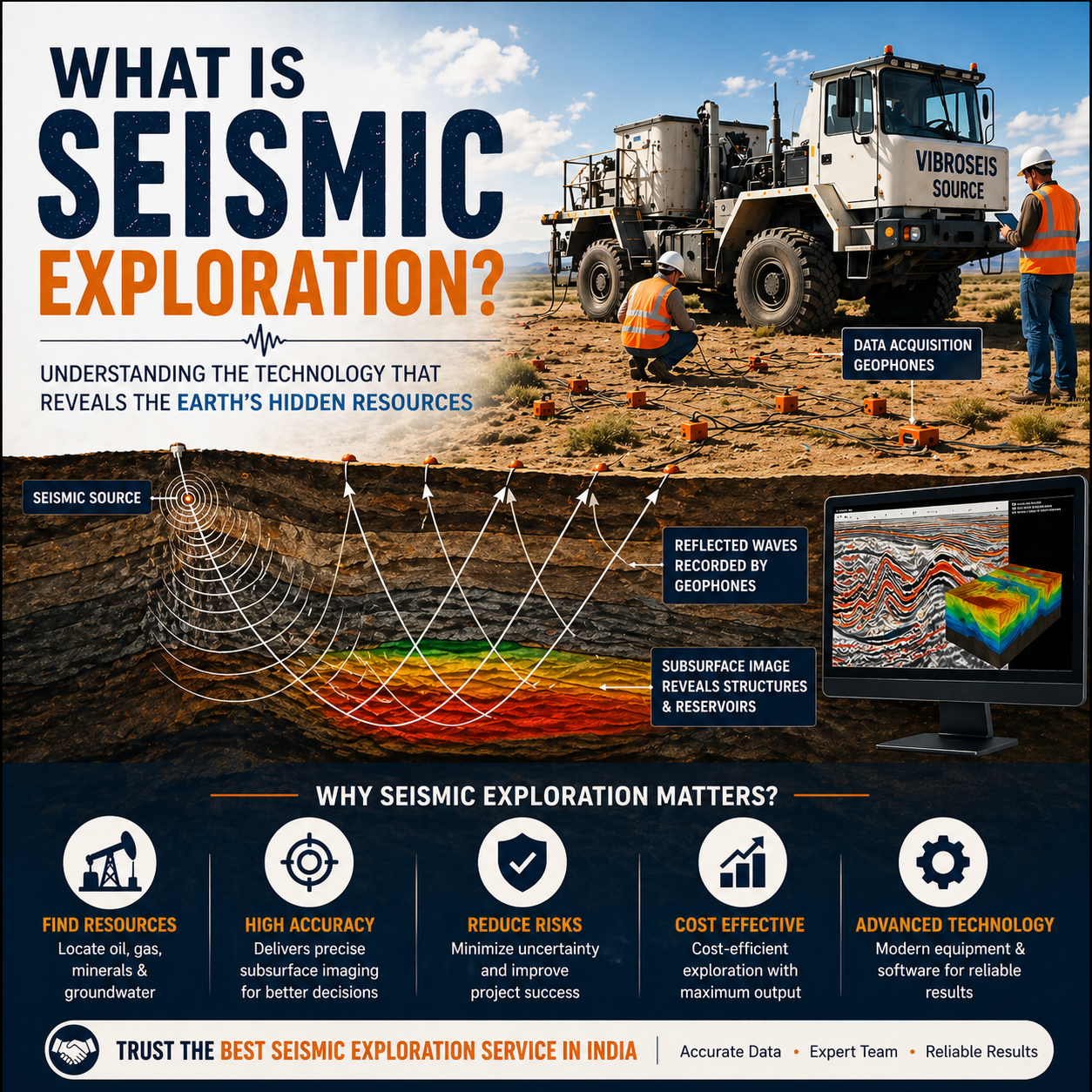
Seismic exploration is a geophysical method that uses sound waves (seismic waves) to map underground structures. These waves travel through the Earth and reflect back when they encounter different layers of rock or materials.
By analyzing these reflected waves, scientists and engineers can create detailed images of the subsurface. This helps identify natural resources such as oil, gas, minerals, and even groundwater.
In simple terms, seismic exploration works like an ultrasound scan of the Earth.
Why is Seismic Exploration Important?
Seismic exploration plays a crucial role in multiple industries:
- Oil & Gas Industry: Helps locate oil and gas reserves deep underground
- Mining: Identifies mineral deposits
- Construction: Assesses ground stability before building projects
- Environmental Studies: Helps monitor earthquakes and underground changes
Companies offering the best Seismic exploration Service in India use advanced technologies to deliver accurate and reliable data for these industries.
How Does Seismic Exploration Work?
The process of seismic exploration involves several steps:
1. Generation of Seismic Waves
Energy sources such as vibrators (on land) or air guns (in water) are used to generate seismic waves.
2. Wave Propagation
These waves travel through different layers of the Earth.
3. Reflection and Refraction
When waves hit different materials, they bounce back or change direction.
4. Data Collection
Sensors called geophones (on land) or hydrophones (in water) record the returning waves.
5. Data Processing
The recorded data is processed using advanced software to create a subsurface image.
The best Seismic exploration Service in India ensures high-quality data acquisition and processing for accurate results.
Types of Seismic Exploration
There are mainly two types of seismic exploration:
1. 2D Seismic Survey
- Provides a flat, cross-sectional view of the Earth
- Used for initial exploration
- Cost-effective but less detailed
2. 3D Seismic Survey
- Creates a detailed 3D image of subsurface structures
- Highly accurate and widely used in modern exploration
- Essential for decision-making in oil & gas projects
Some advanced companies even use 4D seismic surveys to monitor changes over time. The best Seismic exploration Service in India often offers all these solutions based on project requirements.
Applications of Seismic Exploration
Seismic exploration has a wide range of applications:
- Hydrocarbon Exploration: Finding oil and natural gas reserves
- Geotechnical Studies: Understanding soil and rock conditions
- Earthquake Research: Studying seismic activity and fault lines
- Infrastructure Development: Supporting large construction projects
Choosing the best Seismic exploration Service in India ensures reliable insights that help in making informed decisions.
Advantages of Seismic Exploration
- Non-invasive technique (does not require deep drilling initially)
- High accuracy in mapping subsurface structures
- Cost-effective for large-scale exploration
- Supports risk reduction in projects
With modern advancements, the best Seismic exploration Service in India uses cutting-edge technology to improve accuracy and efficiency.
Challenges in Seismic Exploration
While seismic exploration is highly effective, it also comes with some challenges:
- High initial cost for equipment and surveys
- Complex data interpretation
- Environmental concerns in sensitive areas
- Requirement of skilled professionals
However, experienced providers of the best Seismic exploration Service in India are equipped to handle these challenges efficiently.
Future of Seismic Exploration
The future of seismic exploration is driven by technology:
- Artificial Intelligence (AI) for faster data processing
- Machine learning for improved accuracy
- Real-time monitoring systems
- Environment-friendly exploration techniques
These innovations are making seismic exploration more efficient and sustainable.
Conclusion
Seismic exploration is a powerful and essential tool for understanding the Earth’s subsurface. From discovering natural resources to supporting infrastructure development, it plays a vital role in modern industries.
For beginners, understanding the basics of seismic exploration opens the door to a fascinating field that combines science, technology, and engineering. Choosing the best Seismic exploration Service in India ensures accurate data, reliable insights, and successful project outcomes.